
Chasing Coltrane's Ghost
Pilgrimage Liner Notes 02

Liner notes are one of the most distinctive and whimsical art forms to emerge from twentieth-century culture. They blurred the boundaries between instruction manual, poetry, manifesto, and secular sermon—and they deserve a deeper exploration as a potential medium for Afrofluxus media ecology, including in PanAfrican literary experimentation, musical collaboration, and jazz poetics.
◒
You open the sleeve and suddenly you’re in a smoky club at two in the morning.
The waitress is wiping glasses, and someone is leaning on the piano.
The trumpet player is staring into a drink with the blues in his eyes.
Your wave down the bartender, and wait for the band to play.
◓
To understand liner notes, it helps to remember the analog experience of jazz during the mid-century era. A listener did not encounter new music as a stream of digital tracks. They held an album in their hands—it was personal, tactile, and wrapped in beautiful art and typography. While the first soft crackle of sound emerged from the speakers, you turned the sleeve over and began to read. The liner notes became a kind of (un)spoken introduction, the way an MC warms up a room. Rather than relying on dry musicology, the best liner notes are evocative and atmospheric, conjuring a doorway for the reader-listener to walk through:
A crossroads portal. A hoodoo’s tesseract.
◐
You open the sleeve and suddenly you are in a speakeasy on the Cowrie Moon.
The trumpet player is flirting with the singer. He might yet convince her to take him home. The drummer is watching them—jealous and in love.
Your order a stiff drink, and wait for the band to fight.
◑
Many liner notes were written in a style that feels close to jazz poetry—loose, rhythmic sentences that mimic improvisation. They evoke style. They might mention the Mississippi Delta, a Chicago street corner, or a Harlem after-hours jam session. Instead of simply explaining the music technically, they tell you why the artist made specific choices, or how the musicians move their bodies while they play. This is why liner notes matter so much to the culture of jazz. They helped write the mythology around the music. They framed the record not just as entertainment but as an artifact of a particular night, a particular room, a particular group of musicians gobbling up something holy together.
◓
Jazz liner notes are Afrofuturist field notes. They’re a missing link between literary and griot traditions. They’re postcards for time travelers.
◒
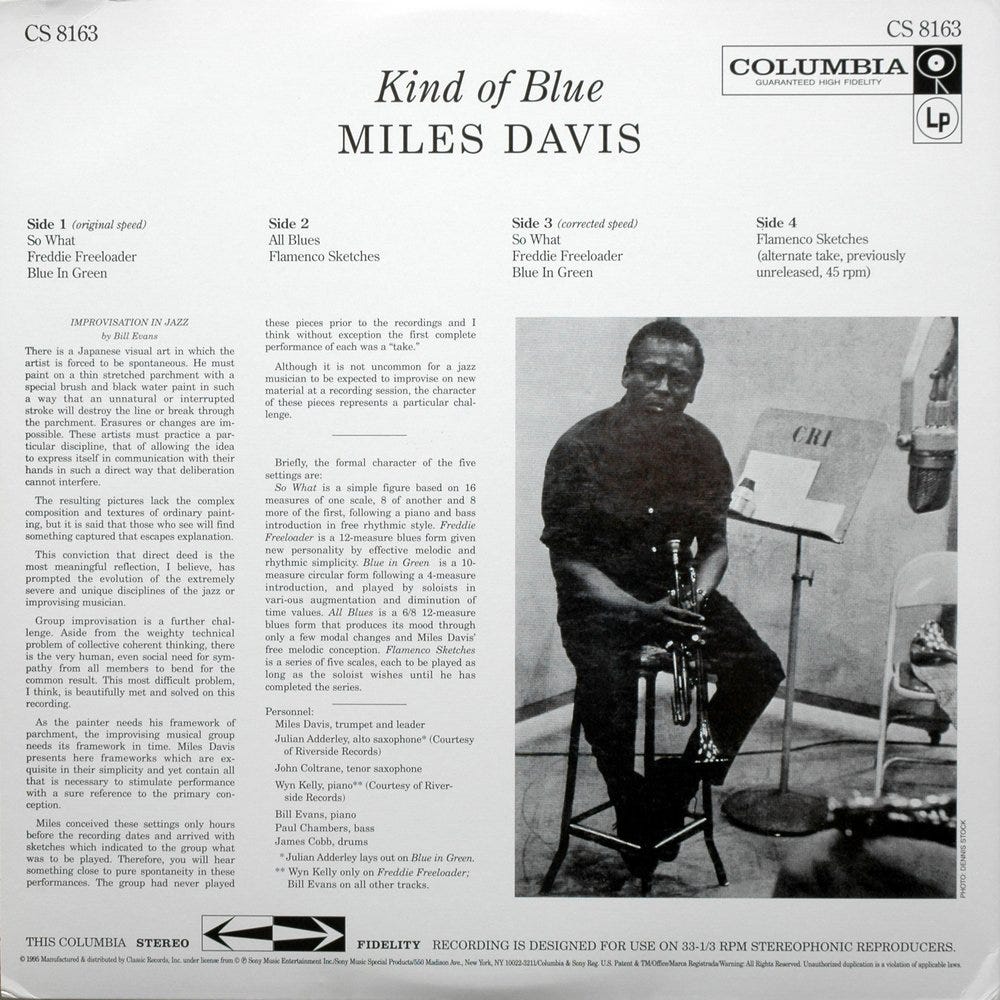
Take the famous liner notes for Kind of Blue by Miles Davis, written by pianist Bill Evans. Evans focuses on Japanese calligraphy. He explains how the brushstroke must be made in a single movement, with total commitment. Once the stroke is made, it cannot be corrected. Jazz improvisation works the same way. The note exists only in that instant. In a few paragraphs, the listener suddenly understands the philosophy behind the album:
“There is a Japanese visual art in which the artist is forced to be spontaneous. He must paint on a thin stretched parchment with a special brush and black water paint…such that an unnatural or interrupted stroke will destroy the line or break through the parchment. Erasures or changes are impossible.”
Another powerful example comes from the world of spiritual jazz. Spiritual jazz was less a strict genre than a philosophical orientation toward sound. The musicians involved believed that music could alter consciousness, communicate with unseen realms, and reconnect listeners with ancestral memory. The writing mirrored the music’s purpose: to open a doorway. The liner notes for albums by artists like John and Alice Coltrane, Pharoah Sanders, and Sun Ra often read like cosmic manifestos. They talk about “alter destiny,” space travel, and supersonic sound. In these notes, jazz is not just another genre of Black music—it’s a mature and embodied modern cosmology—Afrofuturist and avant-garde.
◐
“I was drawn to jazz because it felt like mind music to me. It was a way to experience thought without thinking (that is, to experience bodily the map of someone else’s thinking without needing to write my own story on top of it to comprehend it). I found atmospheres compelling. Similarly, to read a Henry James novel was to be in an atmosphere of manners, where action and emotional response were embedded in an elaborate orchestration of adjacency: to read was to wander next to. And to listen to jazz was to enter a space inside the space in which I was living, one that lifted the top off the day or stretched the day beyond itself. I wanted to know what was happening—how this was happening—so I often turned to the liner notes of my LPs for answers. I saw them as a sort of foyer to the music: preparatory time for listening, a way of sublimating. You had to drop down into something to hear jazz, to be there for it—not having it as your background music but rather as a force carving lines into your brain. Jazz asked something of me that was like writing. To listen was to write, I had at some point concluded, and for a few years I tried to figure out the nature of that relationship. I wanted to know how listening was like making something, and what that something might look like.
—Renee Gladman, Liner Notes: A Way into the Invisible, Paris Review (2017)
◑
Sun Ra’s records especially treated liner notes as part of the performance. Sometimes they read like transmissions from another planet. Other times they sounded like a time traveler’s sermons about Black liberation, Ancient Egypt, and the future of humanity. Sun Ra employed what he termed the “space key,” a modal or droning foundation from which multiple improvisational choices could be made. This often included “space chords,” produced by wind instruments simultaneously playing notes of their choice, resulting in a collective sonic texture rather than traditional harmony. He pioneered dense percussion, and group improvisation long before “free jazz” became a movement, and his label El Saturn Records was among the first artist-run imprints in Black American music.
◒
““Easy Street” reveals, in its second eight bars, a few runs and cascades that come more from the hands than from the song. This is how Sun Ra often intervenes on a standard—by bringing physicality back into the picture, the part of piano playing that is unsung: the un-song. It is a literal “reach”—the sound of the hand extending itself.”
—Vijay Iyer, Liner notes to Sun Ra, Monorails and Satellites: Volumes 1, 2, and 3
◓
Alice Coltrane’s most transcendent albums (such as Journey in Satchidananda and Universal Consciousness) emerged during a period when she was studying Carnatic music, Vedantic philosophy, and Hindu meditation. Her music blended jazz improvisation with Indian devotional traditions and cosmic themes, producing soundscapes intended as spiritual journeys for the listener. In her later years, when she established an ashram in California, her jazz music literally became part of a religious practice. South Asian chanting and spiritual instruction merged with Afrocentric cultural foundations. This was musical fusion that transcended racial, gendered, and national borders.
◐
“Jazz is an African music. It grew in America but it comes from Africa.”
—African Rhythms: The Autobiography of Randy Weston (2010)
◑
Jazz liner notes are accessible Afrofuturist wayfinding. The liner notes act as a map—not a strict explanation but a constellation of clues that guide the listener through the soundscape pilgrimage. There is also something deeply nocturnal about the form. Many liner notes evoke the time when jazz historically thrived: late at night. They archive the witching hour when the crowd has thinned, the band starts stretching out into longer improvisations, and the music becomes less about performance and more about intimate yet public conversations between fellow midnight-magician-musicians seeking the same North Star.
◓
“When I realized that jazz is God, it’s God speaking to me. And my trying to speak back to god—that is jazz. The only thing I try to do is get that feeling. And what is that feeling? That feeling is jazz. That’s what it is. And it’s always been that.”
—Harlem jazz musician Sonny Rollins, The Upside of Jazz
◒
The reader-listener becomes part of the song, carried along like a little white paper boat down the River Jordan.
Amen, àṣẹ, selah.
I stopped reading this soon after beginning and found the "Kind of Blue" album on YouTube, then continued reading. Though it didn't have the crackling magic, the sound, the feel of vinyl, it was still a magic nonetheless when paired with your words. This is an intoxicating piece. It put me in a club somewhere late at night. The band playing for themselves before a thinned crowd, as you describe. It's a moment, a sense of nirvana, of existing not in the past, the future, but in the present, completely in the present. While what crowd remains nods their heads collectively, tap their feet, while a couple dances slowly and a little drunkenly, while everything is everything and in motion, there is that stillness. This the stillness, the peace, the slice of time cut from the rest of it just for one; no one else shares it, no one else can.
Your references, your quotes, how your words part around them like a river while carrying their essence, and yours, downstream, are deftly done.
This is educational and joyful, and artful, and I will return to it and your page.
Great work.
One day you will write my liner notesss because this soooooooooo beautiful